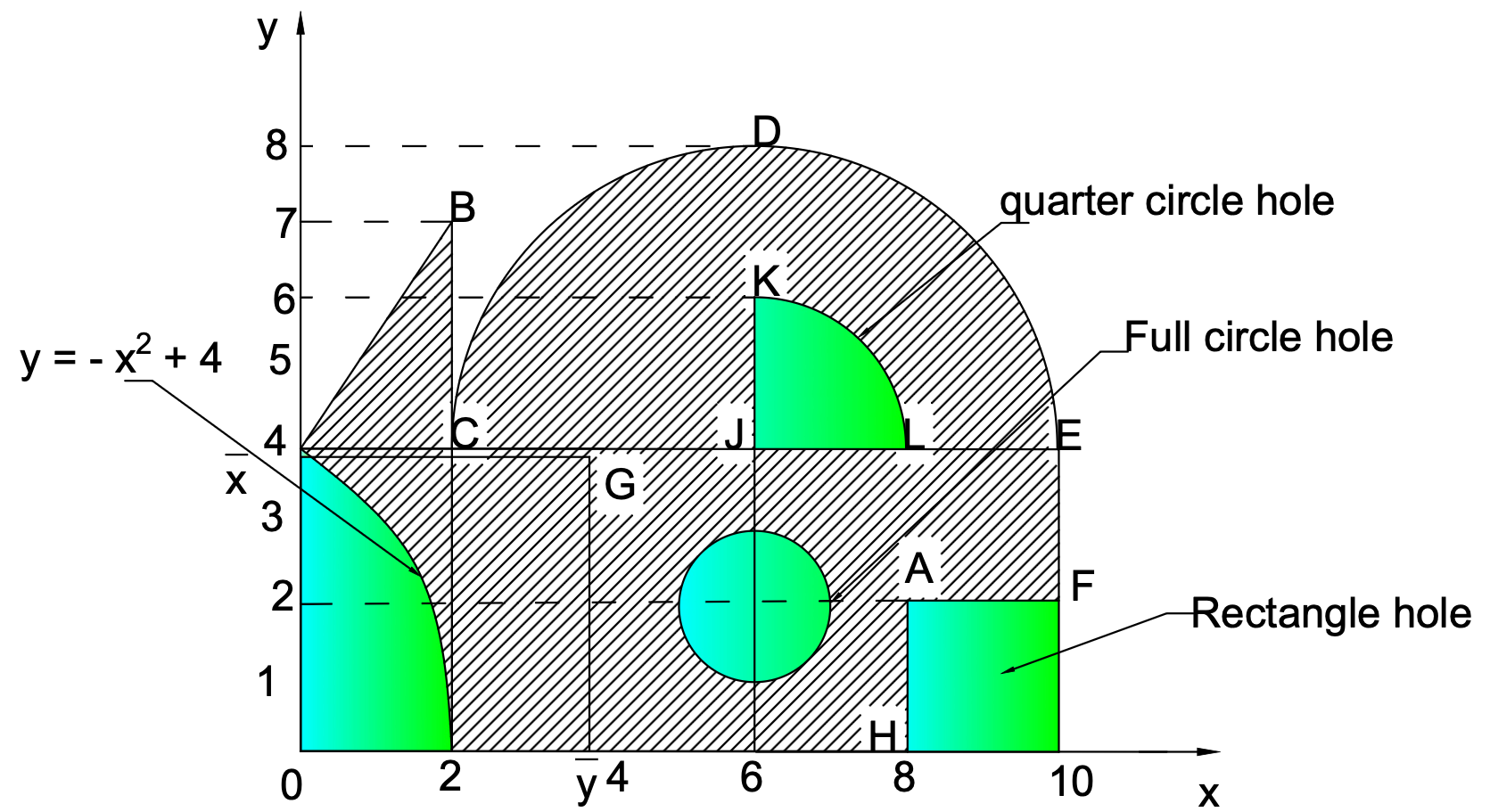
Centroids, Center of Gravity & Distributed Loads
Center of Gravity, Centroids of 2D/3D Composite Bodies, Integration for Curved Boundaries, and Distributed Loads
5.1 Centroid Locations: 2-D Objects (Common Shapes)
5.1.1 Centroid Location of 2-D Objects (with Common Shapes)
Figure 5.1 illustrates a flat plate whose surface area \(A\) (in the \(x-y\) plane) is much larger than its uniform thickness \(t\) along the \(z\)-direction. In this configuration, the total weight \(W\) of the plate acts at its center of gravity \(G(\bar{x}, \bar{y})\). The fundamental objective of this section is to develop and apply the formulas required to compute the coordinates of the centroid and center of gravity.
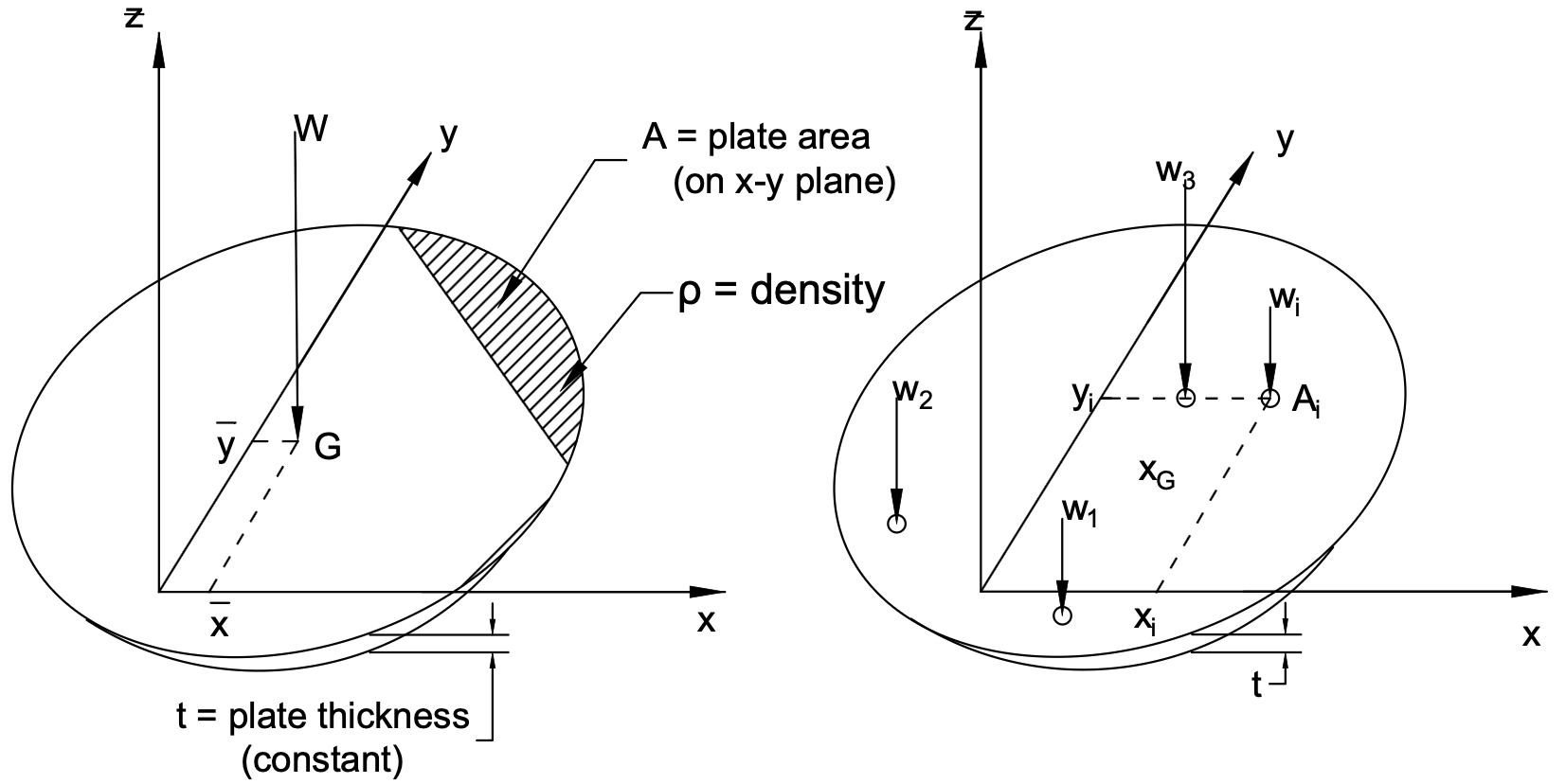
Let \(\rho\) denote the uniform material density of the plate. We can conceptualize this plate as composed of thousands of discrete particles, where each particle \(i\) has its own weight \(w_i = \rho \cdot t \cdot A_i\) and coordinates \((x_i, y_i)\). The resultant weight \(W\) of the entire body is the sum of these elemental weights:
Applying the principle of moments (Varignon\'s Theorem), the moment of the resultant weight about any coordinate axis equals the sum of the moments of the individual particle weights. Taking moments about the \(x\)-axis and \(y\)-axis yields:
Substituting \(w_i = \rho \cdot t \cdot A_i\) and \(W = \rho \cdot t \cdot A\), the density \(\rho\) and uniform thickness \(t\) cancel out, giving the definitive formulas for the centroid of area of a composite 2-D body:
Before analyzing composite bodies, let us review the centroid locations of fundamental 2-D geometric shapes.
Properties of Triangular Centroids:
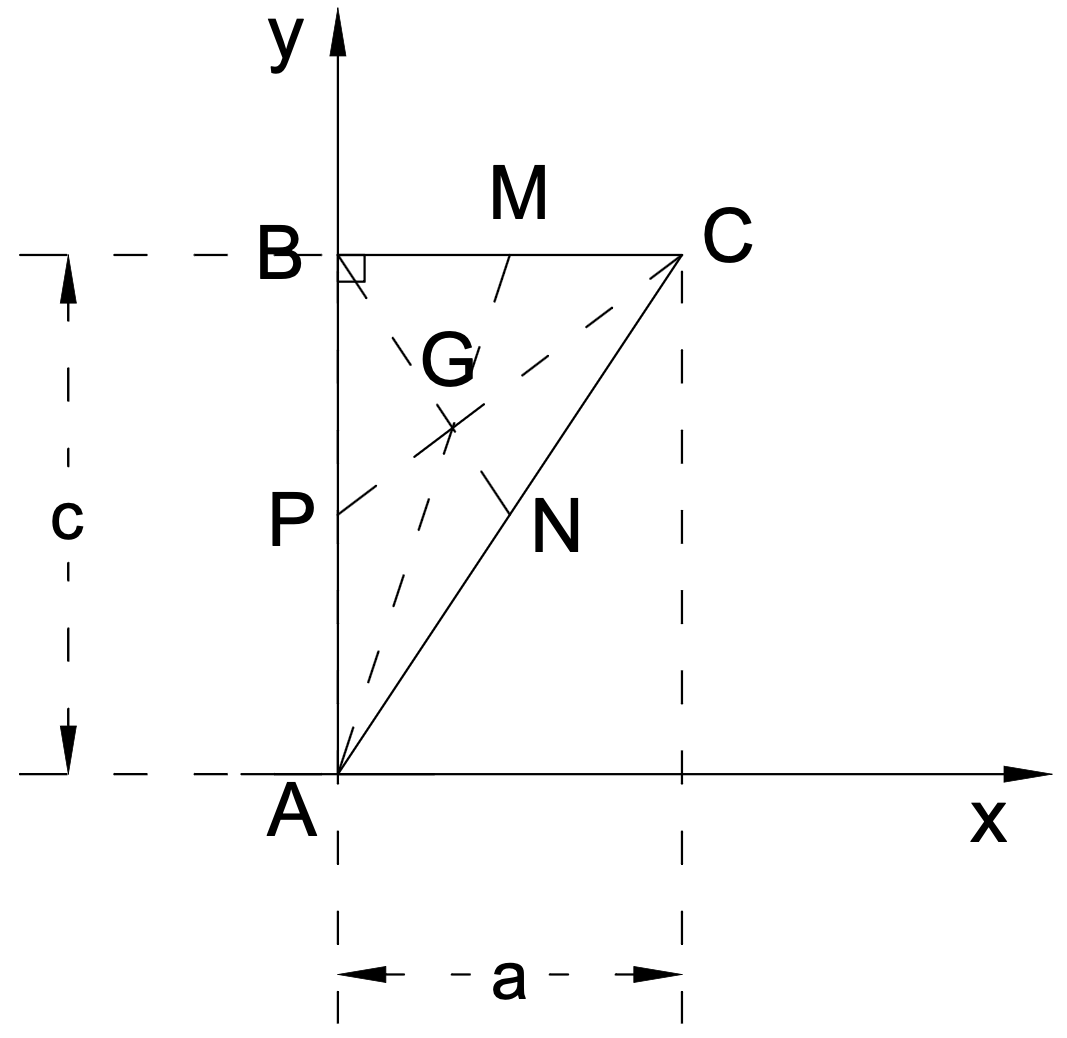
Consider a general triangle \(ABC\) with vertices and opposite side midpoints \(M, N, P\). The three median lines \(AM, BN, CP\) intersect at a single point \(G\), which is the centroid of the triangle (Figure 5.2). The centroid divides each median into segments with the ratio \(2:1\):
Important Geometric Rules for Triangular Centroids:
- Rule 1 (Ratio Rule): The centroid \(G\) is always located at a distance of \(\frac{2}{3}\) of the median length from any vertex, or \(\frac{1}{3}\) of the median length from the opposite midpoint.
- Rule 2 (Median Line): Connect a vertex to the midpoint of the opposite side.
- Rule 3 (Division): Divide the median into 3 equal segments; \(G\) is 2 segments away from the vertex and 1 segment away from the base midpoint.
- Rule 4 (Similar Triangles): Construct similar triangles along the median line to find horizontal and vertical coordinates.
- Rule 5 (Equal Ratios): Equate coordinate ratios to establish centroid distances, as shown in Figures 5.3 through 5.5.
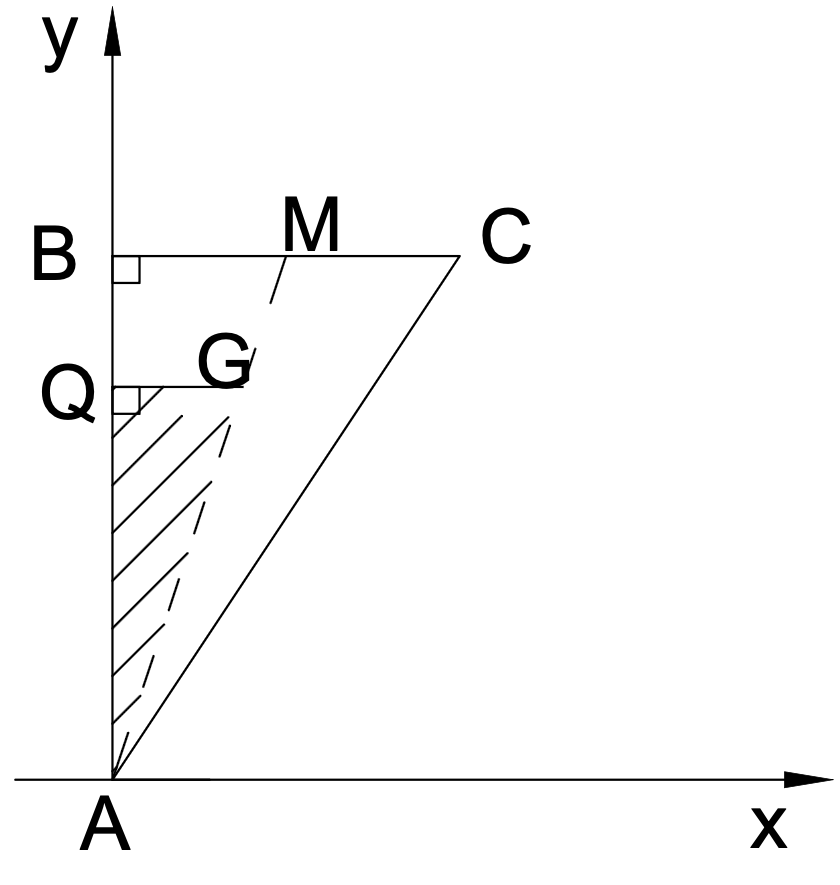
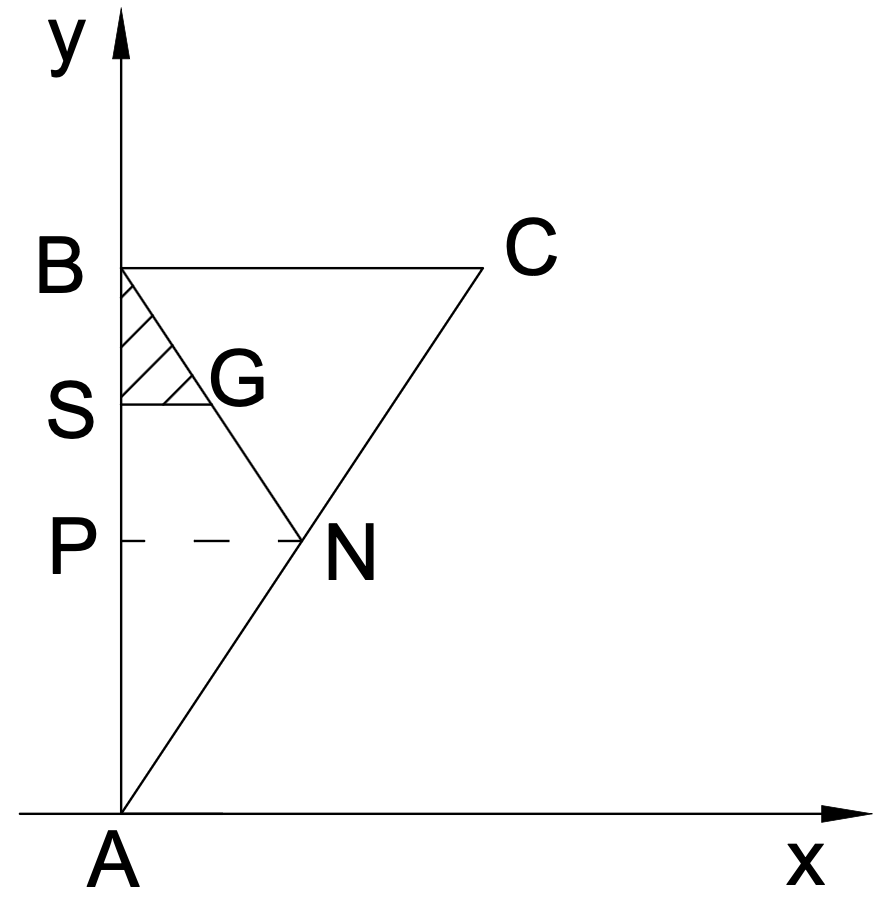
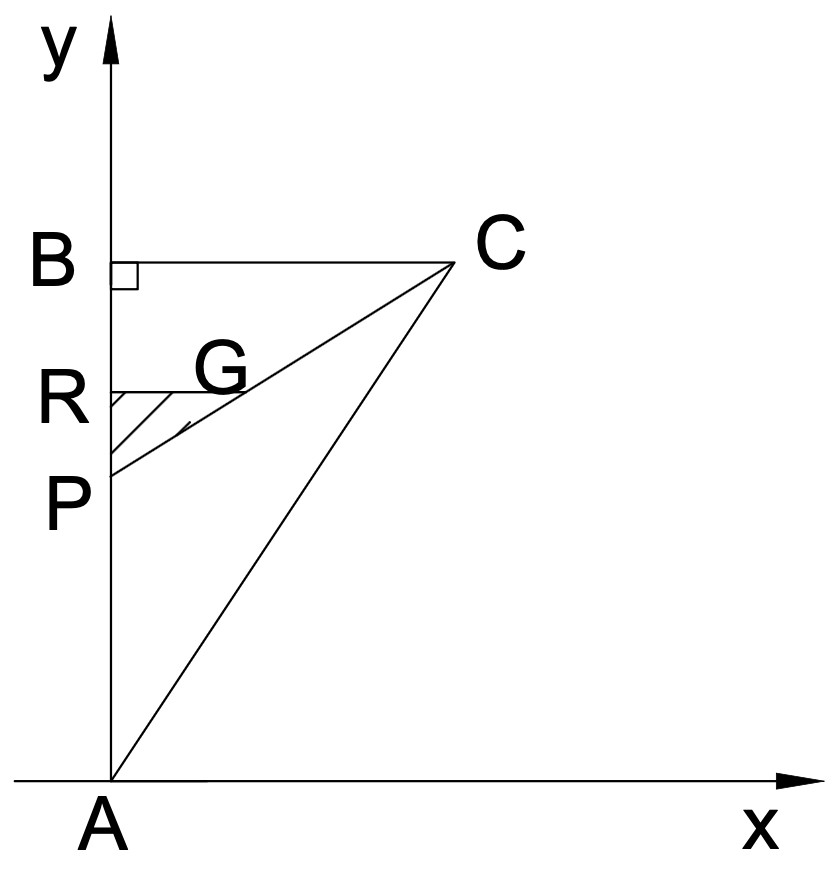
Figure 5.6 summarizes the centroid locations for standard 2-D shapes commonly encountered in engineering problems, including rectangles, right triangles, semicircles, circles, and circular sectors:
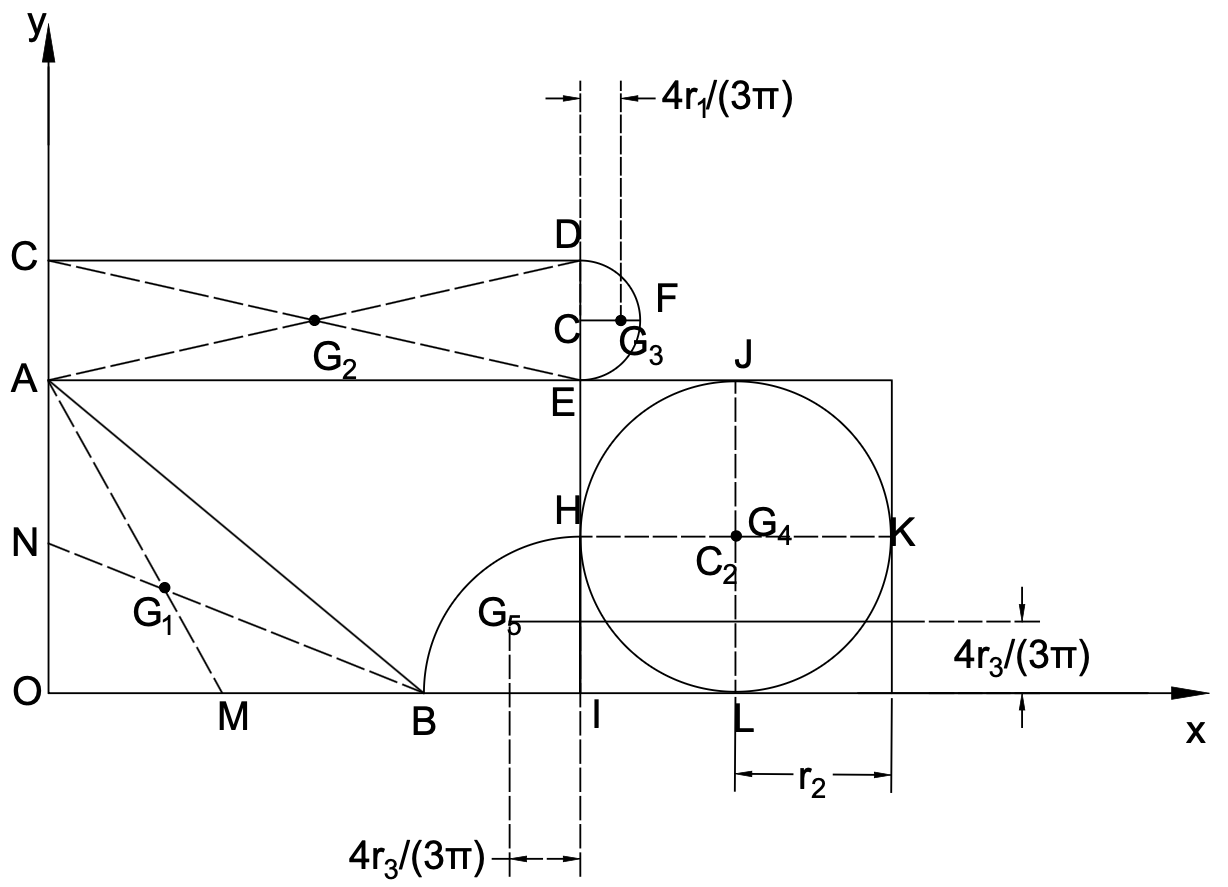
- Rectangle (base \(b\), height \(h\)): \(A = b \cdot h\), \(\bar{x} = \frac{b}{2}\), \(\bar{y} = \frac{h}{2}\)
- Right Triangle (base \(b\), height \(h\)): \(A = \frac{1}{2} b \cdot h\), \(\bar{x} = \frac{b}{3}\), \(\bar{y} = \frac{h}{3}\) (measured from the right-angle corner)
- Semicircle (radius \(r\)): \(A = \frac{\pi r^2}{2}\), \(\bar{y} = \frac{4r}{3\pi}\) from the diameter base
- Quarter-Circle (radius \(r\)): \(A = \frac{\pi r^2}{4}\), \(\bar{x} = \frac{4r}{3\pi}\), \(\bar{y} = \frac{4r}{3\pi}\) from the center corner
- Circular Sector (radius \(r\), total angle \(2\alpha\)): \(A = \alpha r^2\), \(\bar{x} = \frac{2r\sin\alpha}{3\alpha}\), \(\bar{y} = 0\) (with \(\alpha\) in radians)
Example 5.1
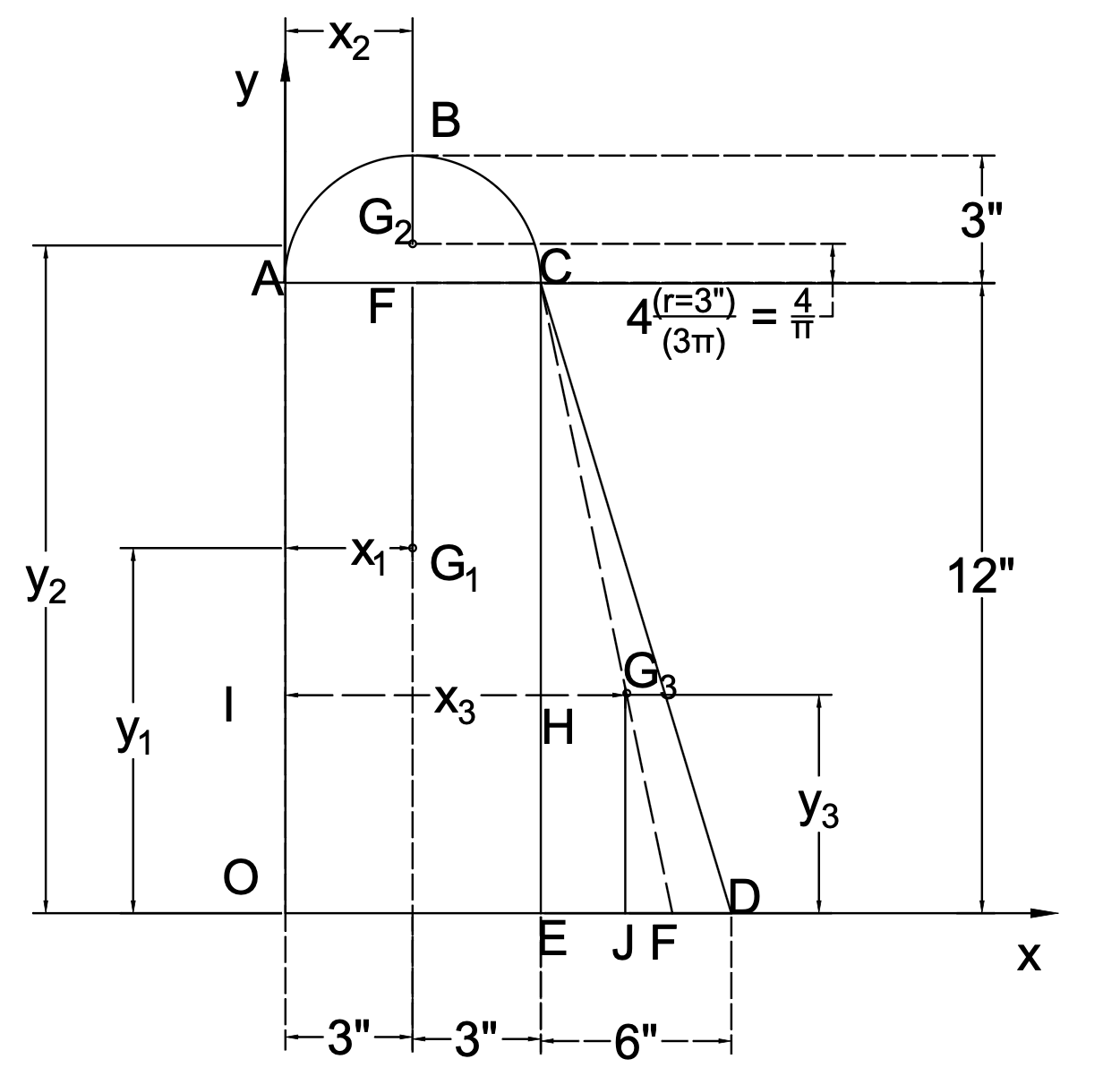
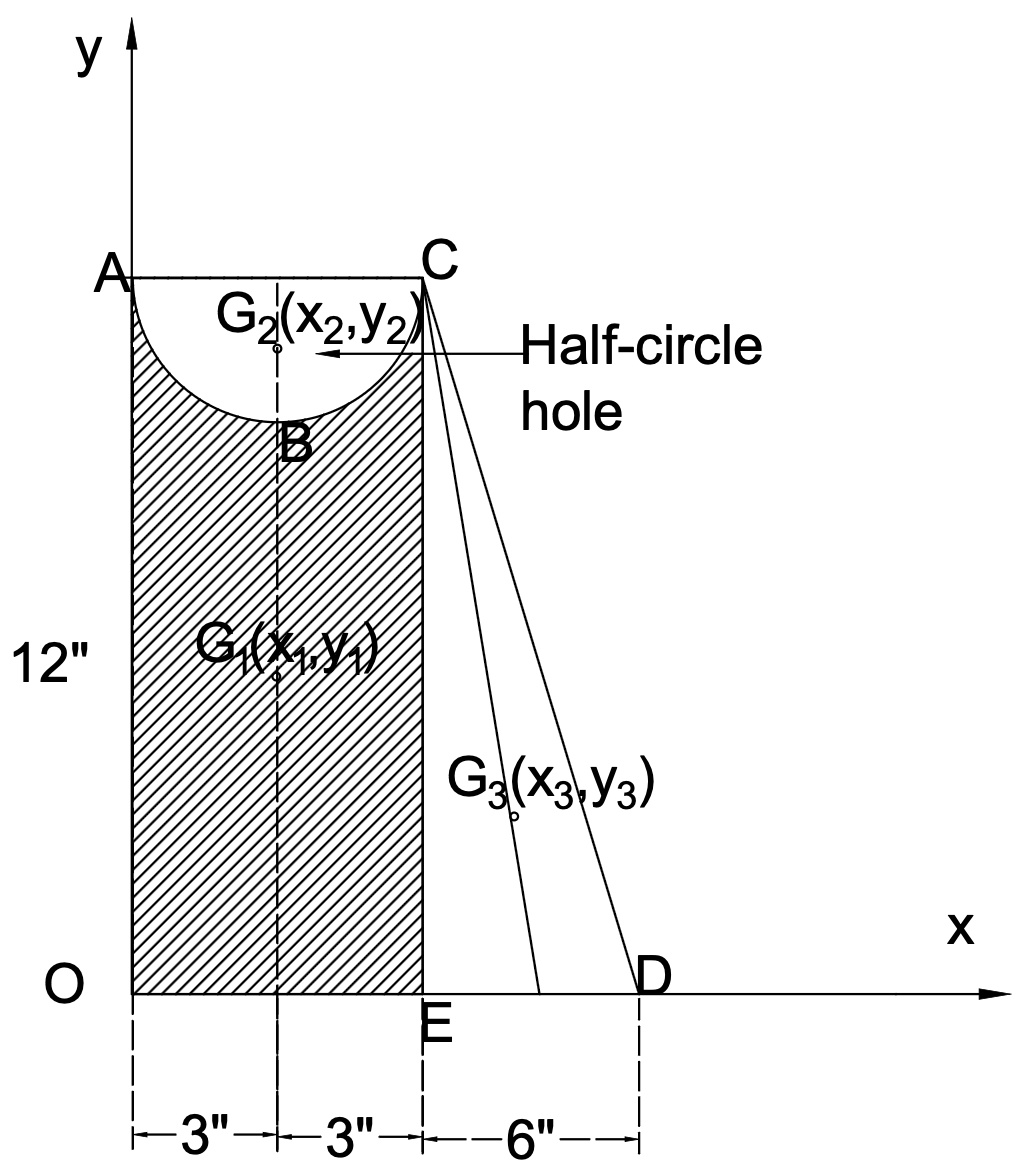
- Rectangle \(OACE\), with centroid location \(G_1(\bar{x}_1, \bar{y}_1)\)
- Half-circle \(ABC\), with centroid location \(G_2(\bar{x}_2, \bar{y}_2)\)
- Triangle \(ECD\), with centroid location \(G_3(\bar{x}_3, \bar{y}_3)\)
Given dimensions: Rectangle base 6 in, height 12 in; Half-circle radius \(r = 3\text{ in}\); Triangle base 6 in, height 12 in.
Solution
To find the centroid coordinates of the composite body, we compute the area and centroid location for each simple component:
1. Rectangle \(OACE\): Base \(b = 6\text{ in}\), height \(h = 12\text{ in}\).
\(\bar{x}_1 = \frac{6}{2} = 3\text{ in}, \quad \bar{y}_1 = \frac{12}{2} = 6\text{ in}\)
2. Half-Circle \(ABC\): Radius \(r = 3\text{ in}\), base on \(y = 12\text{ in}\).
\(\bar{x}_2 = 3\text{ in}, \quad \bar{y}_2 = 12 + \frac{4(3)}{3\pi} = 12 + \frac{4}{\pi} \approx 13.27\text{ in}\)
3. Triangle \(ECD\): Base \(b = 6\text{ in}\), height \(h = 12\text{ in}\).
\(\bar{x}_3 = 6 + \frac{2}{3}(3) = 8\text{ in}, \quad \bar{y}_3 = \frac{1}{3}(12) = 4\text{ in}\)
| Component # | \(A_i\) (\(\text{in}^2\)) | \(\bar{x}_i\) (\(\text{in}\)) | \(\bar{y}_i\) (\(\text{in}\)) | \(A_i \bar{x}_i\) (\(\text{in}^3\)) | \(A_i \bar{y}_i\) (\(\text{in}^3\)) |
|---|---|---|---|---|---|
| 1. Rectangle \(OACE\) | \(72.00\) | \(3.00\) | \(6.00\) | \(216.00\) | \(432.00\) |
| 2. Half-circle \(ABC\) | \(14.14\) | \(3.00\) | \(13.27\) | \(42.42\) | \(187.64\) |
| 3. Triangle \(ECD\) | \(36.00\) | \(8.00\) | \(4.00\) | \(288.00\) | \(144.00\) |
| Total (\(\sum\)) | \(A = 122.14\) | — | — | \(\sum A_i \bar{x}_i = 546.42\) | \(\sum A_i \bar{y}_i = 763.64\) |
Applying Equation (5.3) to compute the composite centroid coordinates:
\(\bar{y} = \frac{\sum A_i \bar{y}_i}{\sum A_i} = \frac{763.64\text{ in}^3}{122.14\text{ in}^2} \approx 6.25\text{ in}\)
Answers: \(\bar{x} = 4.47\text{ in}\) (or \(5.47\text{ in}\)), \(\bar{y} = 6.25\text{ in}\).
Example 5.2
Solution
When an object contains a void or cutout, we treat the cutout as a negative area. Its area and moments of area are subtracted from the totals:
For the semicircular hole of radius \(r = 3\text{ in}\) whose diameter lies along \(y = 12\text{ in}\) (opening downward into the rectangle):
\(\bar{x}_2 = 3\text{ in}\)
\(\bar{y}_2 = 12 - \frac{4(3)}{3\pi} = 12 - \frac{4}{\pi} \approx 12 - 1.27 = 10.73\text{ in}\)
| Component # | \(A_i\) (\(\text{in}^2\)) | \(\bar{x}_i\) (\(\text{in}\)) | \(\bar{y}_i\) (\(\text{in}\)) | \(A_i \bar{x}_i\) (\(\text{in}^3\)) | \(A_i \bar{y}_i\) (\(\text{in}^3\)) |
|---|---|---|---|---|---|
| 1. Rectangle \(OACE\) | \(72.00\) | \(3.00\) | \(6.00\) | \(216.00\) | \(432.00\) |
| 2. Half-circle Hole \(ABC\) | \(-14.14\) | \(3.00\) | \(10.73\) | \(-42.42\) | \(-151.72\) |
| 3. Triangle \(ECD\) | \(36.00\) | \(8.00\) | \(4.00\) | \(288.00\) | \(144.00\) |
| Total (\(\sum\)) | \(A = 93.86\) | — | — | \(\sum A_i \bar{x}_i = 461.58\) | \(\sum A_i \bar{y}_i = 424.28\) |
Applying Equation (5.3) for the composite centroid with cutout:
\(\bar{y} = \frac{\sum A_i \bar{y}_i}{\sum A_i} = \frac{424.28\text{ in}^3}{93.86\text{ in}^2} \approx 4.52\text{ in}\)
Answers: \(\bar{x} = 4.92\text{ in}\), \(\bar{y} = 4.52\text{ in}\).
5.2 Centroid Locations: 2-D Objects with Curved Boundaries
5.2.1 Integration Method for Curved Boundaries
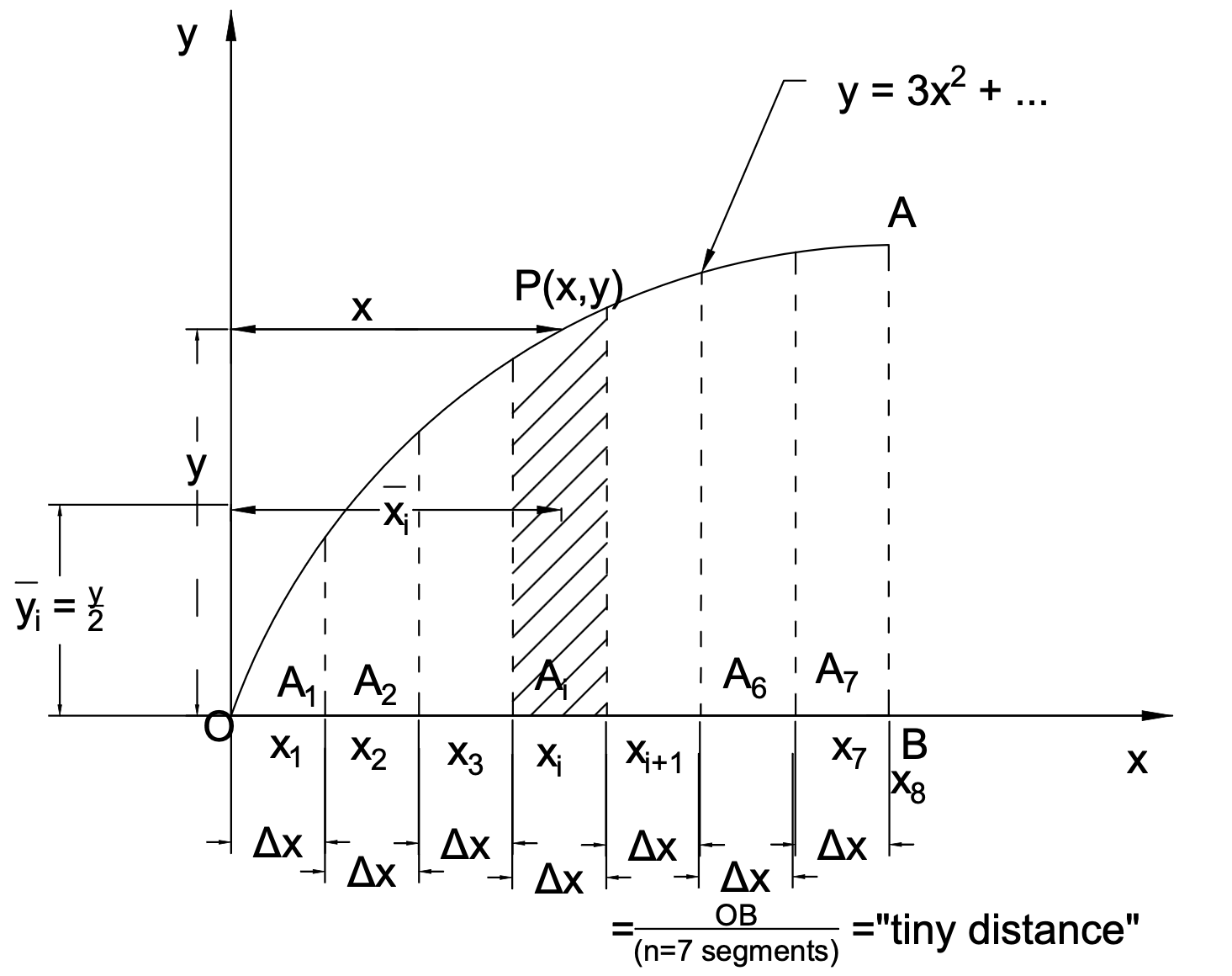
When the boundary of a 2-D area is defined by a mathematical curve \(y = f(x)\) or \(x = g(y)\), the centroid cannot be computed simply from standard geometric formulas. Instead, we divide the area into infinitesimal differential elements \(dA\) and perform calculus integration (Figure 5.9):
1. Vertical Strip Element:
A vertical strip has width \(dx\) and height \(y\). The differential area element and its elemental centroid \((\bar{x}_{el}, \bar{y}_{el})\) are:
2. Horizontal Strip Element:
A horizontal strip has height \(dy\) and length \(x\). The differential area element and its elemental centroid are:
Integrating over the entire region gives the centroid coordinates:
Example 5.3
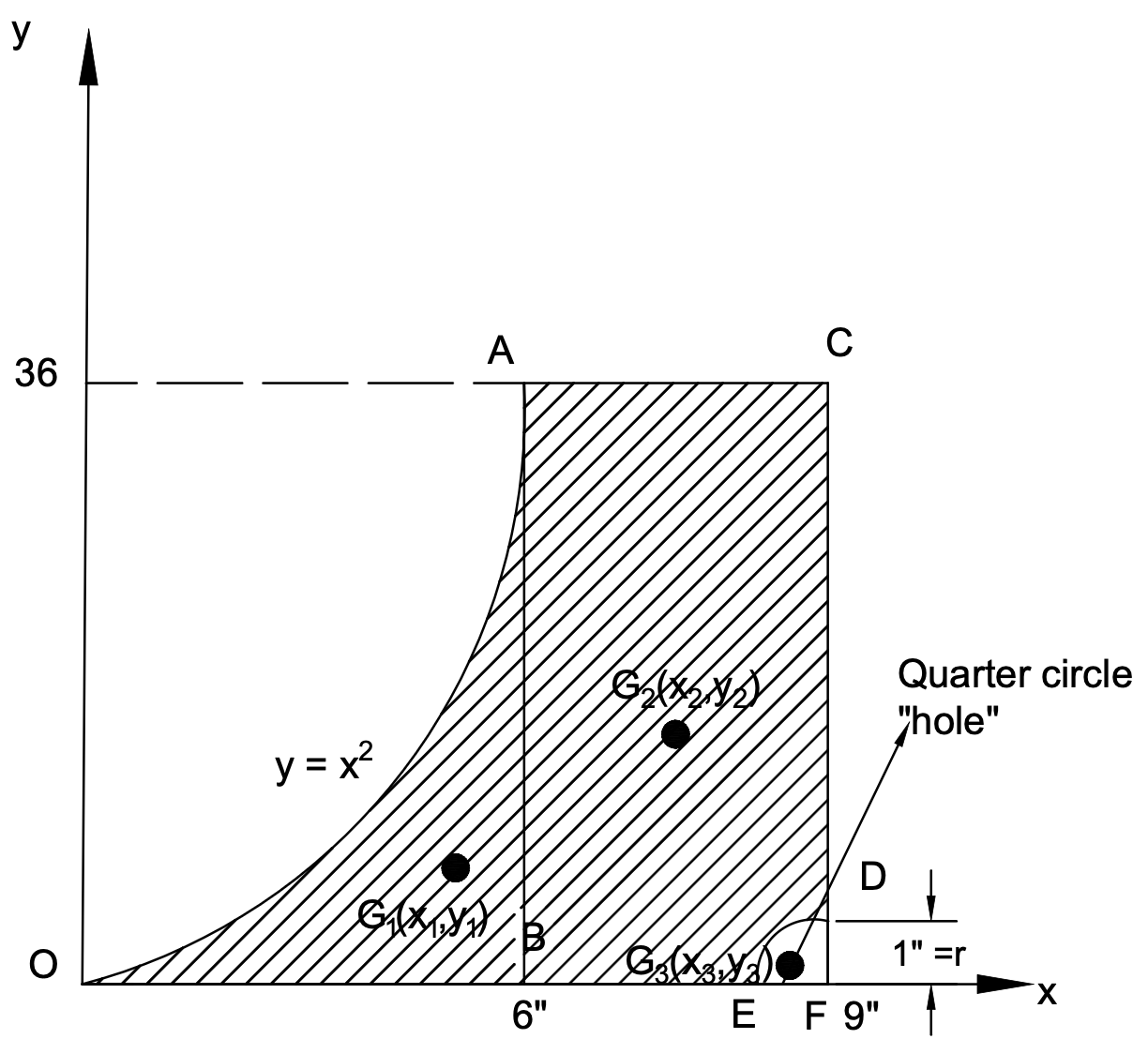
- Component #1: Area under the parabolic curve \(y = x^2\) from \(x = 0\) to \(x = 6\text{ in}\)
- Component #2: Rectangle \(ACFB\) of dimensions \(3\text{ in} \times 36\text{ in}\)
- Component #3: Quarter-circle cutout (hole) of radius \(r = 1\text{ in}\)
Solution
First, determine the area and centroid of the parabolic region under \(y = x^2\) from \(x = 0\) to \(x = 6\text{ in}\) via integration:
\(A_1 \bar{x}_1 = \int_0^6 x (x^2) \, dx = \left[ \frac{x^4}{4} \right]_0^6 = \frac{1296}{4} = 324\text{ in}^3 \implies \bar{x}_1 = \frac{324}{72} = 4.50\text{ in}\)
\(A_1 \bar{y}_1 = \int_0^6 \frac{x^2}{2} (x^2 \, dx) = \frac{1}{2} \left[ \frac{x^5}{5} \right]_0^6 = \frac{7776}{10} = 777.60\text{ in}^3 \implies \bar{y}_1 = \frac{777.60}{72} = 10.80\text{ in}\)
Next, compute components #2 and #3, and assemble the results into Table 5.3:
| Component # | \(A_i\) (\(\text{in}^2\)) | \(\bar{x}_i\) (\(\text{in}\)) | \(\bar{y}_i\) (\(\text{in}\)) | \(A_i \bar{x}_i\) (\(\text{in}^3\)) | \(A_i \bar{y}_i\) (\(\text{in}^3\)) |
|---|---|---|---|---|---|
| 1. Parabolic Area \(A_1\) | \(72.00\) | \(4.50\) | \(10.80\) | \(324.00\) | \(777.60\) |
| 2. Rectangle \(ACFB\) | \(108.00\) | \(7.50\) | \(18.00\) | \(810.00\) | \(1944.00\) |
| 3. Quarter-Circle Hole | \(-0.79\) | \(8.58\) | \(0.42\) | \(-6.74\) | \(-0.33\) |
| Total (\(\sum\)) | \(A = 179.21\) | — | — | \(\sum A_i \bar{x}_i = 1127.26\) | \(\sum A_i \bar{y}_i = 2721.27\) |
Applying Equation (5.8) to determine the overall centroid:
\(\bar{y} = \frac{\sum A_i \bar{y}_i}{\sum A_i} = \frac{2721.27\text{ in}^3}{179.21\text{ in}^2} \approx 15.19\text{ in}\)
Answers: \(\bar{x} \approx 6.29\text{ in}\) (or \(5.89\text{ in}\)), \(\bar{y} \approx 15.19\text{ in}\).
Example 5.4
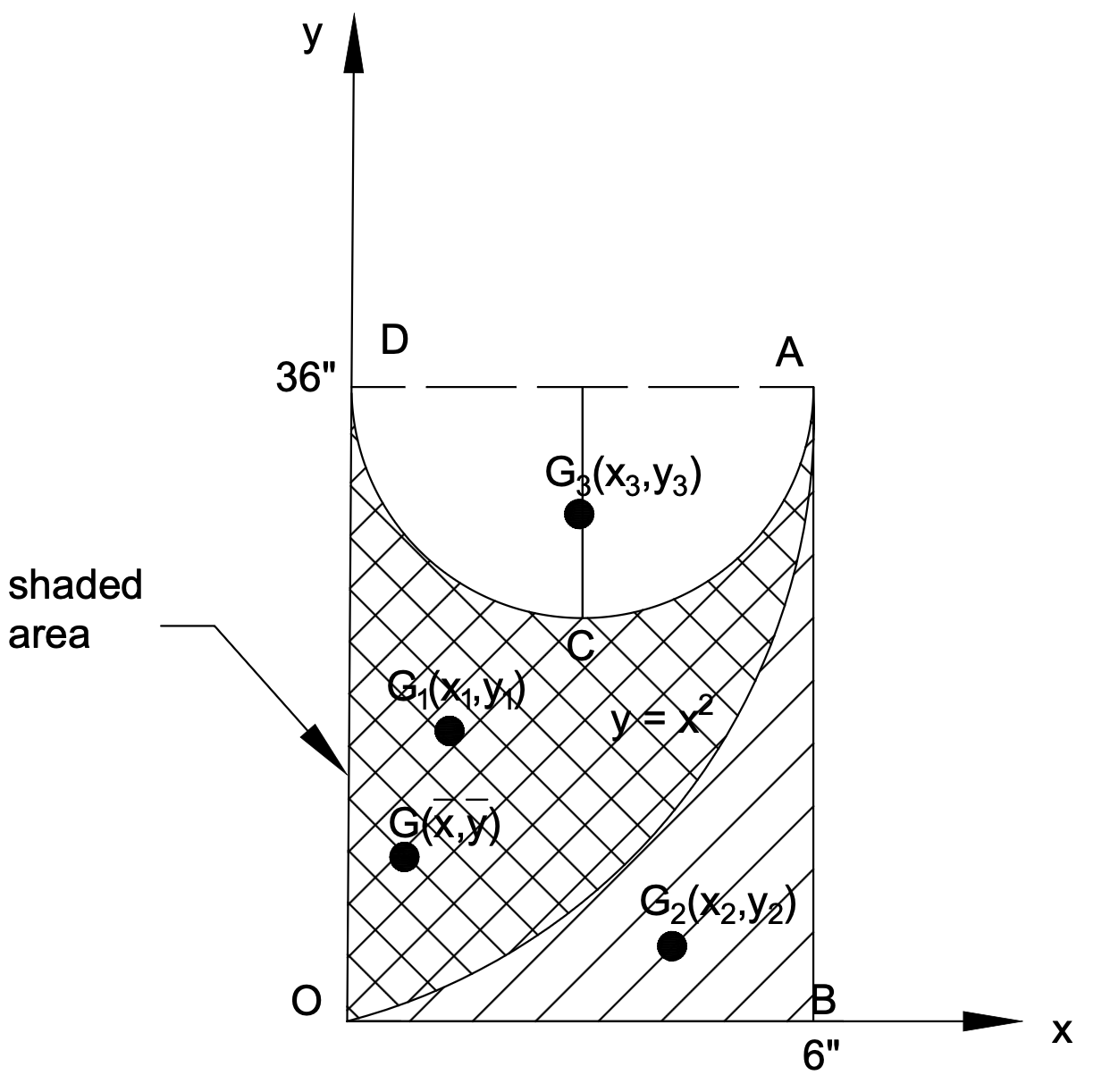
- Component #1: Bounding rectangle \(ODAB\) of dimensions \(6\text{ in} \times 36\text{ in}\)
- Component #2: Area below parabola \(y = x^2\) from \(x = 0\) to \(x = 6\text{ in}\) (hole)
- Component #3: Semicircular cutout \(DCA\) of radius \(r = 3\text{ in}\) (hole)
Solution
We solve this composite problem by subtracting the void below the curve and the semicircular hole from the bounding rectangle:
1. Bounding Rectangle \(ODAB\): Dimensions \(6\text{ in} \times 36\text{ in}\).
2. Parabolic Void under \(y = x^2\) from \(x = 0\) to \(x = 6\text{ in}\):
\(A_2 \bar{x}_2 = -\int_0^6 x (x^2) \, dx = -\left[ \frac{x^4}{4} \right]_0^6 = -324\text{ in}^3 \implies \bar{x}_2 = \frac{-324}{-72} = 4.50\text{ in}\)
\(A_2 \bar{y}_2 = -\int_0^6 \frac{x^2}{2} (x^2) \, dx = -\left[ \frac{x^5}{10} \right]_0^6 = -777.60\text{ in}^3 \implies \bar{y}_2 = \frac{-777.60}{-72} = 10.80\text{ in}\)
3. Semicircular Cutout \(DCA\): Radius \(r = 3\text{ in}\) at the top of the rectangle.
\(\bar{x}_3 = 3\text{ in}, \quad \bar{y}_3 = 36 - \frac{4(3)}{3\pi} \approx 34.73\text{ in}\)
The tabulated values are compiled in Table 5.4:
| Component # | \(A_i\) (\(\text{in}^2\)) | \(\bar{x}_i\) (\(\text{in}\)) | \(\bar{y}_i\) (\(\text{in}\)) | \(A_i \bar{x}_i\) (\(\text{in}^3\)) | \(A_i \bar{y}_i\) (\(\text{in}^3\)) |
|---|---|---|---|---|---|
| 1. Rectangle \(ODAB\) | \(216.00\) | \(3.00\) | \(18.00\) | \(648.00\) | \(3888.00\) |
| 2. Parabolic Void (Hole) | \(-72.00\) | \(4.50\) | \(10.80\) | \(-324.00\) | \(-777.60\) |
| 3. Semicircular Cutout (Hole) | \(-14.14\) | \(3.00\) | \(34.73\) | \(-42.42\) | \(-491.08\) |
| Total Net Area | \(A = 129.86\) | — | — | \(\sum A_i \bar{x}_i = 281.58\) | \(\sum A_i \bar{y}_i = 2619.32\) |
Applying the composite centroid formula:
\(\bar{y} = \frac{\sum A_i \bar{y}_i}{A_{\text{net}}} = \frac{2619.32\text{ in}^3}{129.86\text{ in}^2} \approx 20.17\text{ in}\)
Answers: \(\bar{x} = 2.17\text{ in}\), \(\bar{y} = 20.17\text{ in}\).
5.3 Centroid Locations: 3-D and 1-D Objects
5.3.1 Centroids of 3-D Volumes and 1-D Wires
The centroid concept extends naturally to 3-D volume bodies and 1-D wire frameworks:
Centroid of 3-D Volumes:
For a 3-D body of uniform material density \(\rho\) and total volume \(V\), the coordinates of the centroid are given by the ratio of the first moments of volume to the total volume:
Centroid of 1-D Wires:
When a body consists of a slender wire whose cross-sectional area is small compared to its length \(L\), the centroid coordinates are given by:
Example 5.5
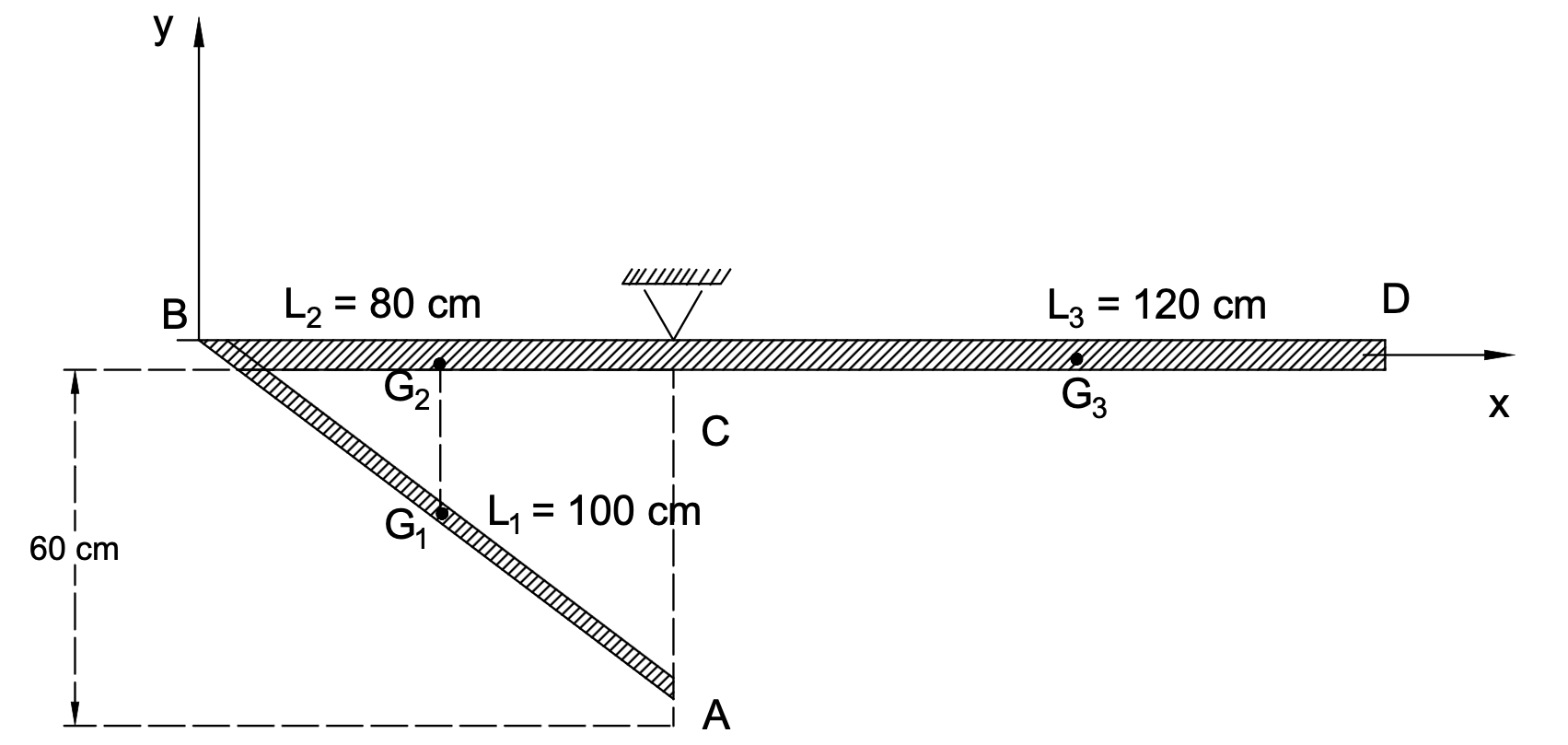
Solution
The composite wire consists of three straight segments:
\(L_2 = BC = 80\text{ cm}, \quad \bar{x}_2 = \frac{80}{2} = 40\text{ cm}\)
\(L_3 = CD = 120\text{ cm}, \quad \bar{x}_3 = 80 + \frac{120}{2} = 140\text{ cm}\)
\(L = L_1 + L_2 + L_3 = 100 + 80 + 120 = 300\text{ cm}\)
The segment properties are summarized in Table 5.5:
| Wire Segment | \(L_i\) (\(\text{cm}\)) | \(\bar{x}_i\) (\(\text{cm}\)) | \(L_i \bar{x}_i\) (\(\text{cm}^2\)) |
|---|---|---|---|
| Segment \(AB\) | \(100.00\) | \(40.00\) | \(4000.00\) |
| Segment \(BC\) | \(80.00\) | \(40.00\) | \(3200.00\) |
| Segment \(CD\) | \(120.00\) | \(140.00\) | \(16800.00\) |
| Total (\(\sum\)) | \(L = 300.00\) | — | \(\sum L_i \bar{x}_i = 24000.00\) |
Applying Equation (5.10):
Answer: \(\bar{x} = 80.00\text{ cm}\) from point \(B\) (coincides with point \(C\)).
Example 5.6
Solution
If the centroid of the entire wire is at point \(C\), then \(\bar{x} = 80\text{ cm}\) measured from point \(B\). Taking moments of length about point \(B\) via Equation (5.10):
\((100 + 80 + L_3)(80) = (100)(40) + (80)(40) + L_3\left(80 + 0.5 L_3\right)\)
\(80 L_3 + 14400 = 4000 + 3200 + 80 L_3 + 0.5 L_3^2\)
\(80 L_3 + 14400 = 7200 + 80 L_3 + 0.5 L_3^2\)
\(0.5 L_3^2 - 7200 = 0 \implies L_3^2 = 14400 \implies L_3 = 120.00\text{ cm}\)
Answer: \(L_3 = 120.00\text{ cm}\).
Example 5.7
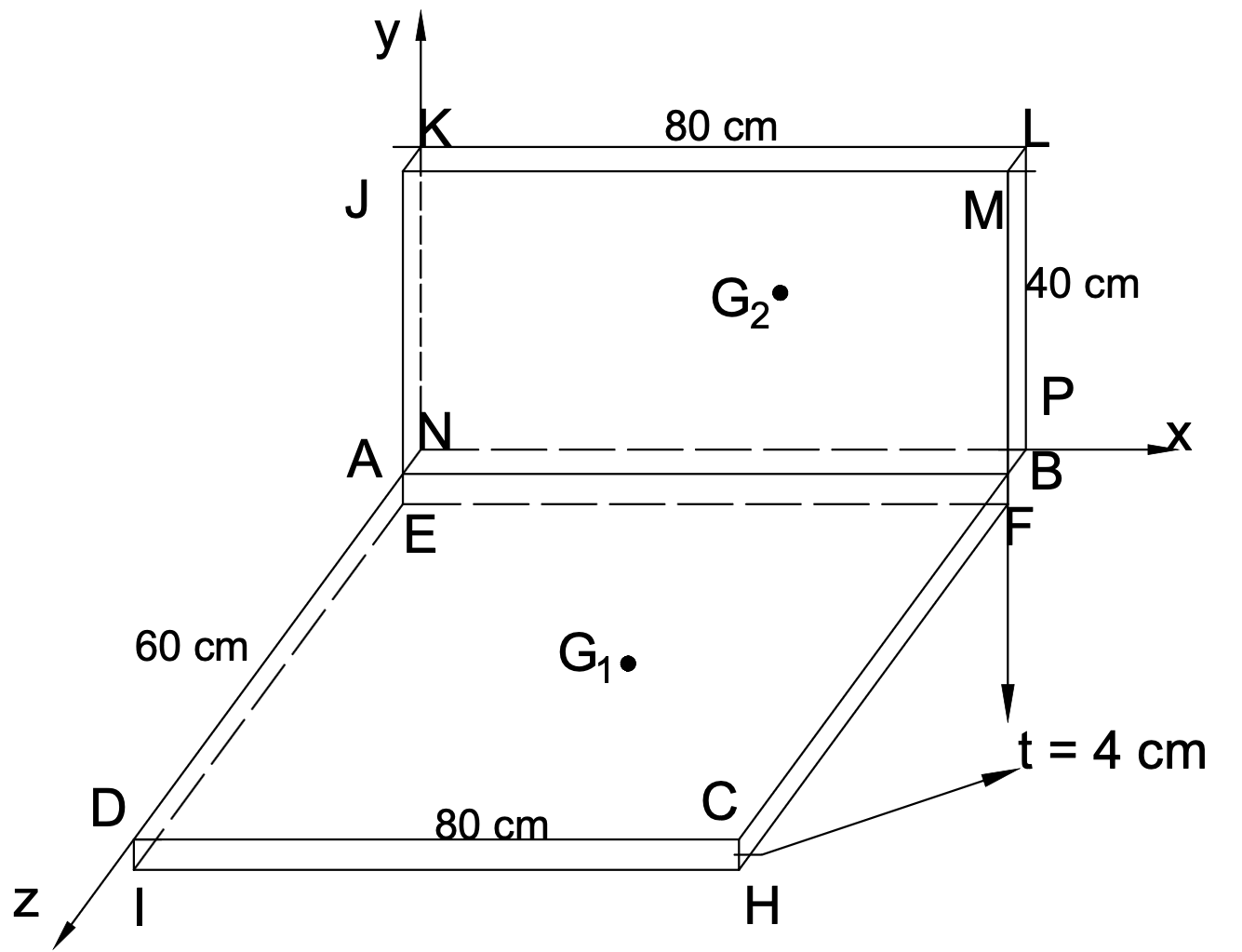
- Plate #1 (\(ABCD\)): Dimensions \(80\text{ cm} \times 60\text{ cm}\), uniform thickness \(t = 4\text{ cm}\)
- Plate #2 (\(AJMB\)): Dimensions \(80\text{ cm} \times 40\text{ cm}\), uniform thickness \(t = 4\text{ cm}\)
Determine the 3-D centroid coordinates \((\bar{x}, \bar{y}, \bar{z})\) of this composite object.
Solution
Calculate the volume and centroid coordinates of each plate:
1. Rectangular Plate #1 (\(ABCD\)):
\(\bar{x}_1 = \frac{80}{2} = 40\text{ cm}, \quad \bar{y}_1 = -\frac{4}{2} = -2\text{ cm}, \quad \bar{z}_1 = \frac{60}{2} + 4 = 34\text{ cm}\)
2. Rectangular Plate #2 (\(AJMB\)):
\(\bar{x}_2 = \frac{80}{2} = 40\text{ cm}, \quad \bar{y}_2 = \frac{40}{2} = 20\text{ cm}, \quad \bar{z}_2 = 0\text{ cm}\)
| Component | \(V_i\) (\(\text{cm}^3\)) | \(\bar{x}_i\) (\(\text{cm}\)) | \(\bar{y}_i\) (\(\text{cm}\)) | \(\bar{z}_i\) (\(\text{cm}\)) | \(V_i \bar{x}_i\) (\(\text{cm}^4\)) | \(V_i \bar{y}_i\) (\(\text{cm}^4\)) | \(V_i \bar{z}_i\) (\(\text{cm}^4\)) |
|---|---|---|---|---|---|---|---|
| Plate #1 (\(ABCD\)) | \(19200\) | \(40.00\) | \(-2.00\) | \(34.00\) | \(768000\) | \(-38400\) | \(652800\) |
| Plate #2 (\(AJMB\)) | \(12800\) | \(40.00\) | \(20.00\) | \(0.00\) | \(512000\) | \(256000\) | \(0\) |
| Total (\(\sum\)) | \(V = 32000\) | — | — | — | \(\sum V_i \bar{x}_i = 1280000\) | \(\sum V_i \bar{y}_i = 217600\) | \(\sum V_i \bar{z}_i = 652800\) |
Applying Equation (5.9) for the 3-D centroid coordinates:
\(\bar{y} = \frac{\sum V_i \bar{y}_i}{\sum V_i} = \frac{217600\text{ cm}^4}{32000\text{ cm}^3} = 6.80\text{ cm}\)
\(\bar{z} = \frac{\sum V_i \bar{z}_i}{\sum V_i} = \frac{652800\text{ cm}^4}{32000\text{ cm}^3} = 20.40\text{ cm}\)
Answers: \(\bar{x} = 40.00\text{ cm}\), \(\bar{y} = 6.80\text{ cm}\), \(\bar{z} = 20.40\text{ cm}\).
5.4 User Friendly Application and Practice Problems
5.4.1 Description of User Friendly Application
Based on the analytical formulations presented in Chapter 5, a user-friendly application has been developed with an intuitive, menu-driven interface, interactive graphical displays of composite shapes, and automated analytical computation of centroid coordinates \((\bar{x}, \bar{y})\) and moments of inertia.
Input Data Requirements:
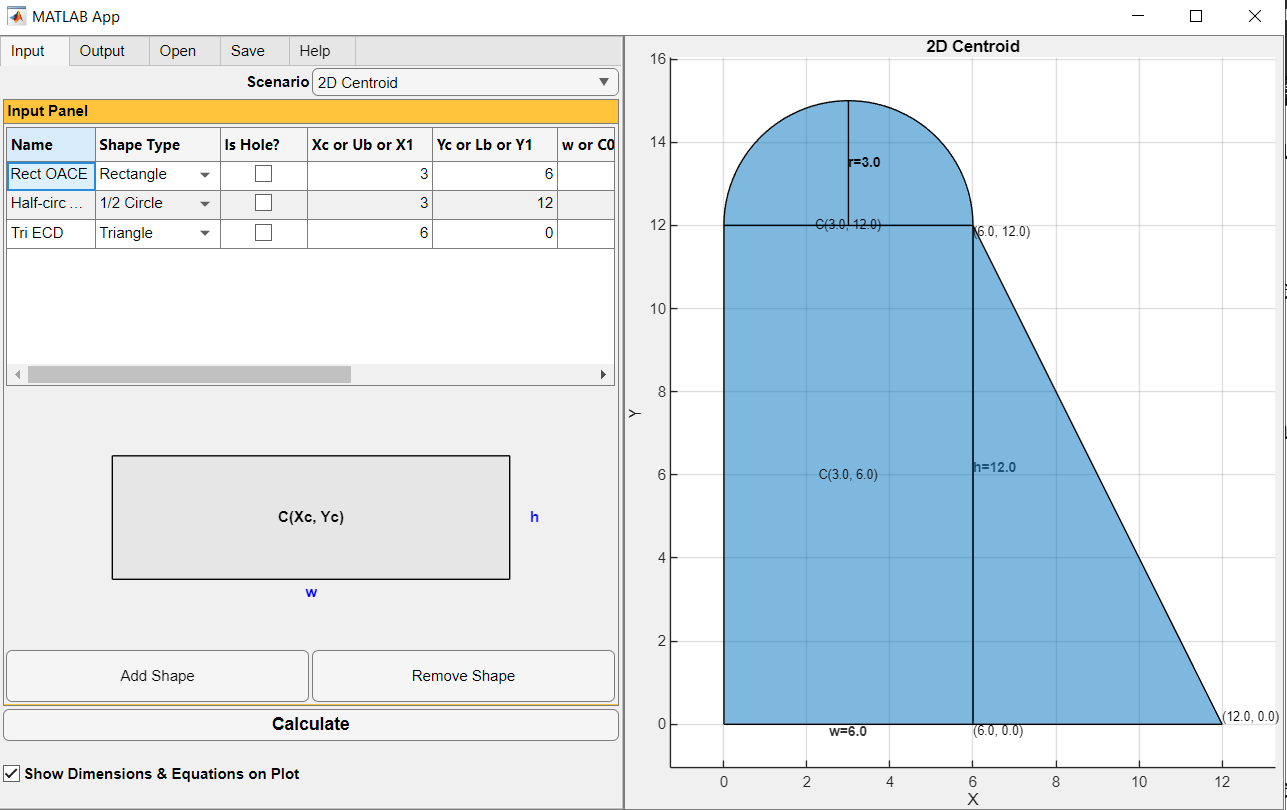
The user selects the analysis scenario (e.g., 2D Composite Shapes) and specifies the geometric parameters in the input table. The application dynamically adjusts input fields for rectangular, triangular, circular, and curved segments.
Output Data and Graphical Verification:
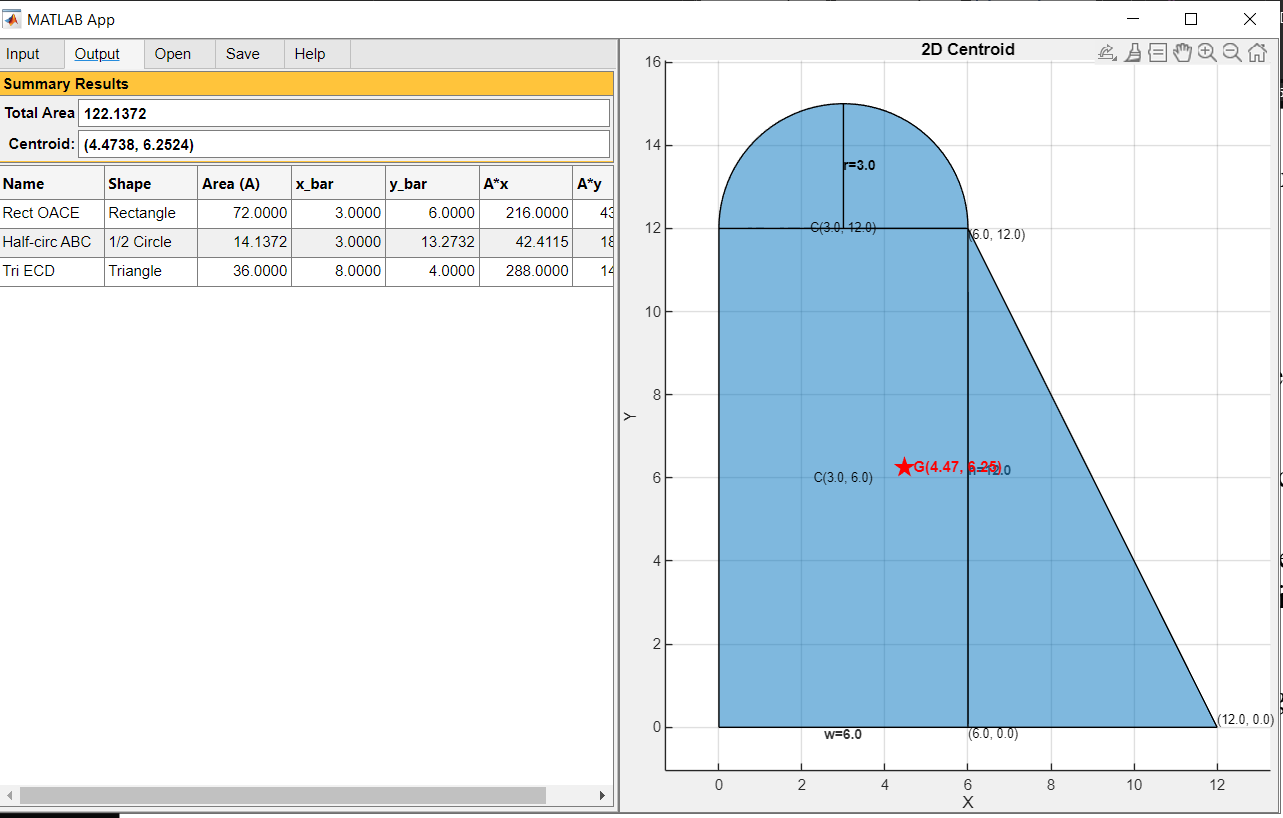
Once the "Calculate" button is clicked, the application computes the total area, first moments of area, and centroid location \(G(\bar{x}, \bar{y})\). The output tab displays the results both numerically and graphically with visual verification (Figure 5.15):
5.4.2 Practice Problems
Solve the following practice problems manually using the tabular composite method, then verify your results using the user-friendly application.
Practice Problem 5.1
- Component #1: Area under parabolic curve with \(L_1 = 6\text{ in}\), \(H_4 = 3\text{ in}\)
- Component #2: Rectangle \(ACFE\) of dimensions \(3\text{ in} \times 33\text{ in}\)
- Component #3: Semicircular hole \(ADC\) with diameter on \(y = 33\text{ in}\)
Find the centroid location \((\bar{x}, \bar{y})\) for this composite shape.
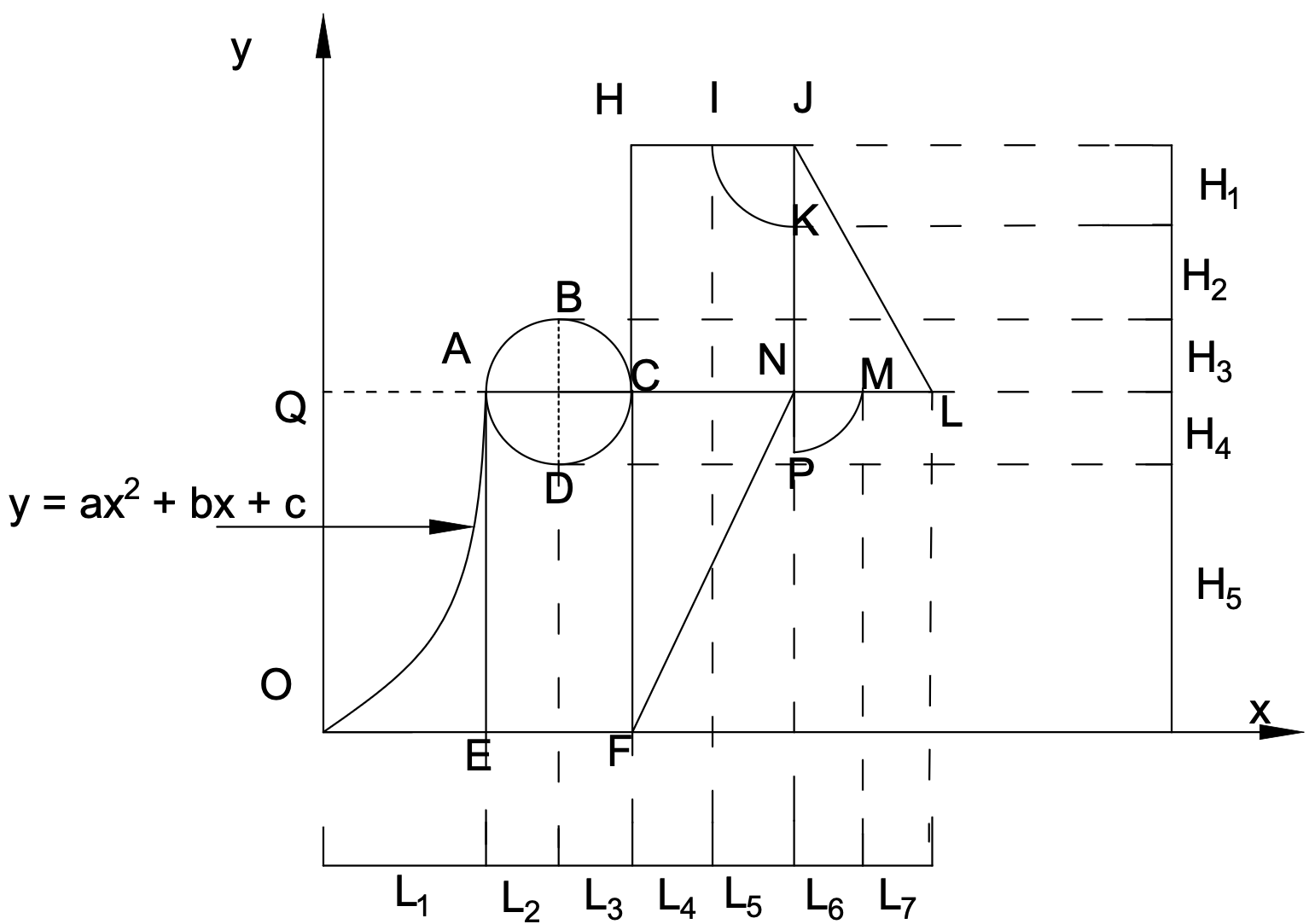
Practice Problem 5.2
- Component #1: Area above the parabola
- Component #2: Rectangle \(ACFE\)
- Component #3: Semicircle \(ABC\)
- Component #4: Triangle \(CNF\)
Find the centroid location \((\bar{x}, \bar{y})\).
Practice Problem 5.3
- Component #1: Triangle \(JLN\)
- Component #2: Rectangle \(HJNC\)
- Component #3: Quarter-circle hole \(IKJ\)
- Component #4: Quarter-circle \(NPM\)
Find the centroid location \((\bar{x}, \bar{y})\).
Practice Problem 5.4
Compute the composite centroid location \((\bar{x}, \bar{y})\).
Practice Problem 5.5
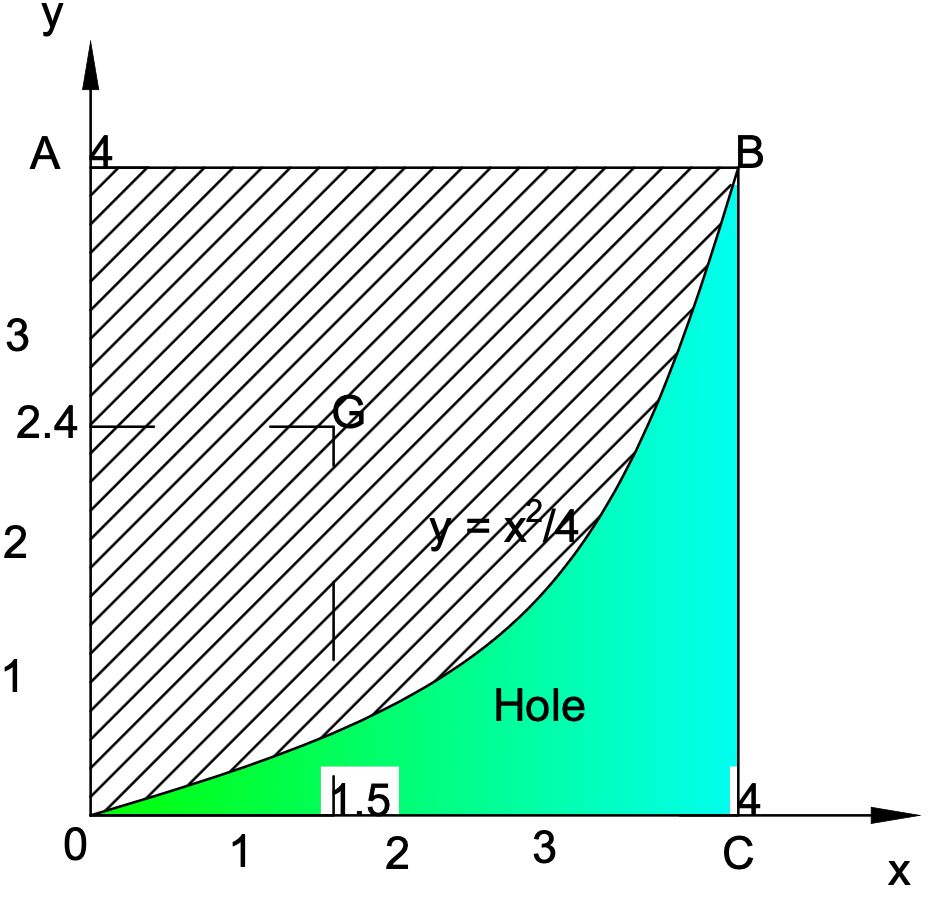
Practice Problem 5.6
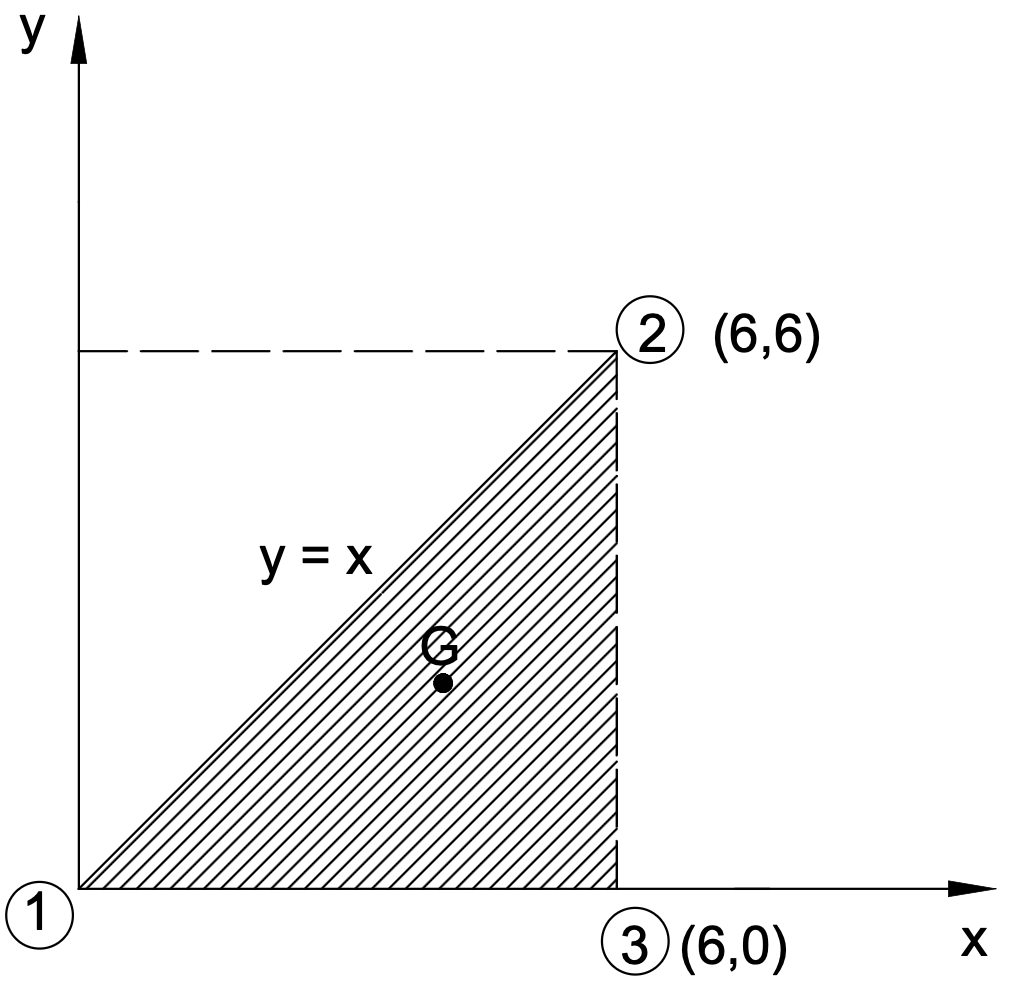
Practice Problem 5.7
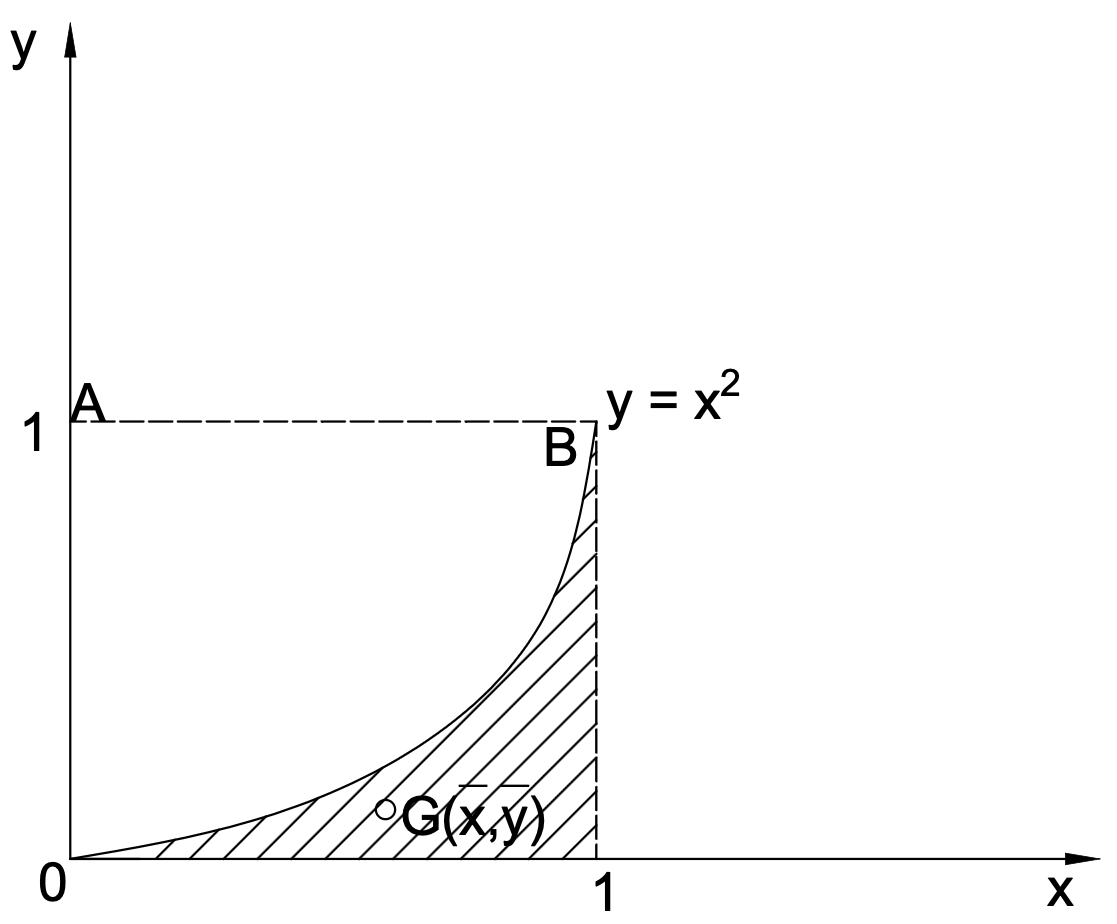
Practice Problem 5.8
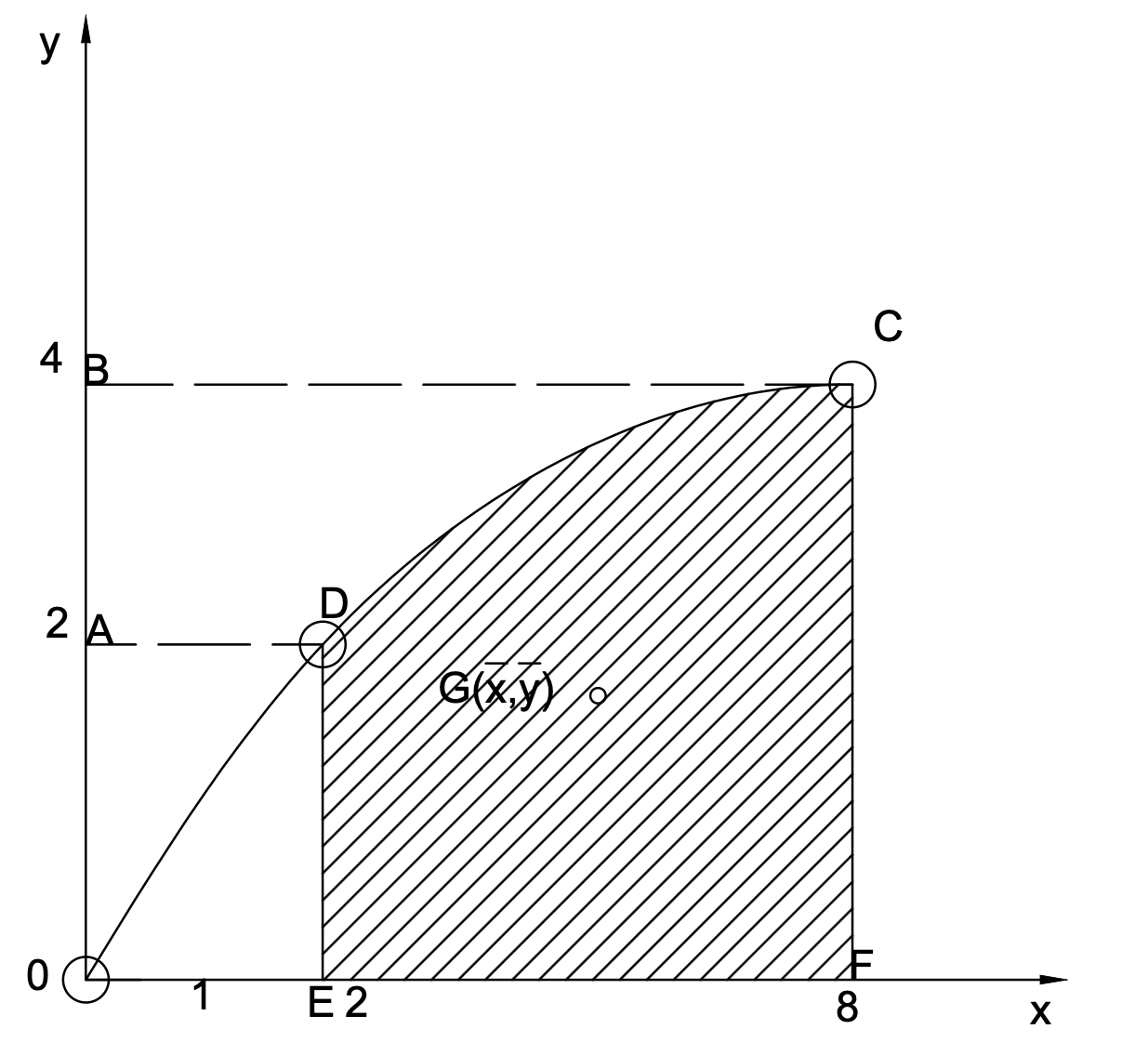
Practice Problem 5.9